








Don Schlitz, one of the most widely revered names in the history of country music songwriting, died April 16 in a Nashville hospital after what was described as a sudden illness. He was 73.
A member of the Country Music Hall of Fame, Schlitz may be best recognized by the public as the sole author of one of country’s most iconic singles, and possibly the genre’s most quoted song ever: “The Gambler,” a country-pop crossover smash for Kenny Rogers in 1978. It was the first song he ever had recorded by someone, but it was not all downhill from there.
Most of his other hits were co-writes, many of them with fellow songwriting legends like Paul Overstreet. The collaborations with Overstreet include “Forever and Ever, Amen,” an 1987 smash in the hands of Randy Travis; other songs for Travis that included “On the Other Hand,” from 1986, and “Deeper Than the Holler,” in 1988; and “When You Say Nothing at All,” made into a country No. 1 by Keith Whitley in 1992 (and also successfully recorded by Alison Krauss & Union Station, plus Ronan Keating, who had a U.K. No. 1 with it in 1999).
Sometimes Schlitz co-wrote with a recording artist, as with “I Feel Lucky,” a smash he co-wrote with its singer, Mary Chapin Carpenter, in 1992, and “He Thinks He’ll Keep Her,” which Carpenter turned into another hit the following year.
He had several enduring hits with the Judds, co-written with their producer, Brett Maher, including “Turn It Loose,” “Rockin’ With the Rhythm of the Rain” and “I Know Where I’m Going,” each of them a No. 1 country hit in the late ’80s for the mother/daughter duo.
Others who recorded his material included Alabama, Sara Evans, Waylon Jennings, George Strait, Ronnie Milsap, Reba McEntire, the Bellamy Brothers, Tanya Tucker, Garth Brooks, Pam Tillis, Sweethearts of the Rodeo, Kathy Mattea, the Oak Ridge Boys and the Nitty Gritty Dirt Band.
Schlitz’s many honors include his inductions into the Nashville Songwriters Association Hall of Fame in 1993, the (New York-based) Songwriters Hall of Fame in 2012, the Country Music Hall of Fame in 2017 and the Grand Ole Opry in 2022.
The Country Hall of Fame is especially notable because Schlitz was only the sixth songwriter to be inducted, at that time. The Opry’s recognization is similarly noteworthy because he was the only non-performing songwriter to be so inducted in the Opry’s history — although he certainly became a performer for his many regular appearances there, as he had in many songwriters’ round appearances at the Bluebird Cafe.
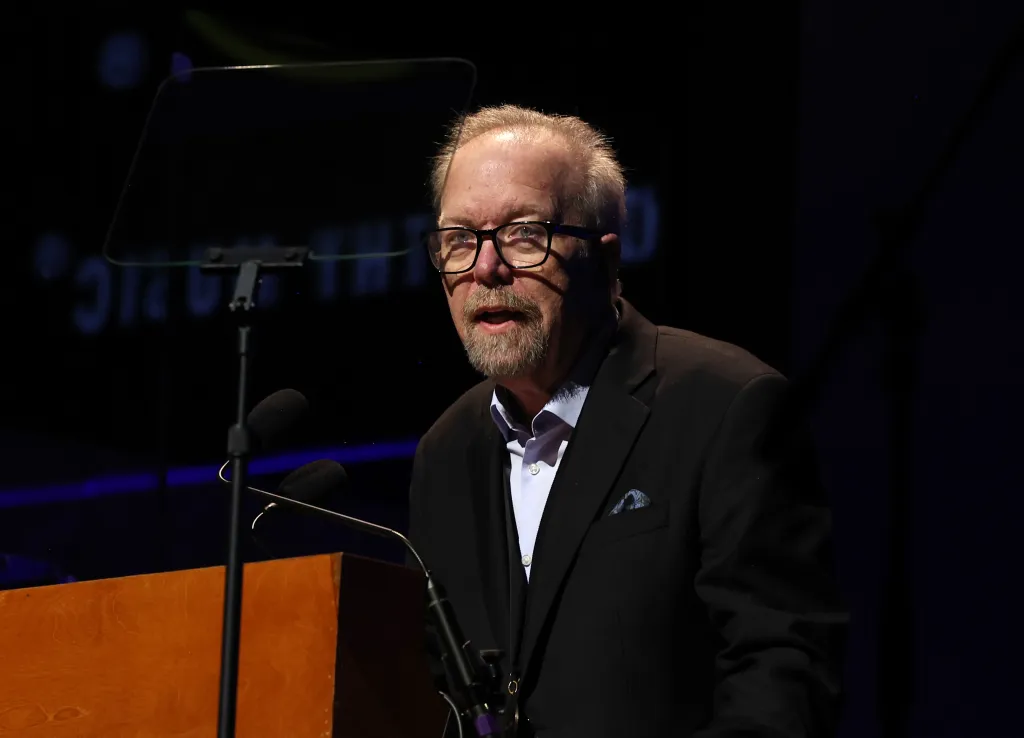
Don Schlitz speaks onstage during the Class of 2023 Medallion Ceremony at Country Music Hall of Fame and Museum on October 22, 2023 in Nashville, Tennessee.
Getty Images for Country Music Hall of Fame and Museum
Awards-wise, “The Gambler” won him the Grammy for best country song in 1978, and it became the CMAs’ song of the year the following year. in the end he won two Grammys, three CMA song of the year prizes and two ACM song of the year awards. He also was named ASCAP Country Songwriter of the Year for four consecutive years, from 1988-91.
His prowess extended to Broadway, when he wrote both music and lyrics for the 1999 musical “The Adventures of Tom Sawyer.”
Schlitz often told the story of how he wrote “The Gambler” when he was 23, working at Vanderbilt University as a computer operator, aspiring to be a writer. One day, without a car, he walked 2-3 miles home from work and wrote the entirety of the song in his head along the way, except for the kicker. “I’m just making up this story song; I’m good at rhymes and meter, so I’m putting that in to it…. When I made it back to my efficiency apartment, I sat down at my dad’s old Smith-Corona typewriter — I’m a pretty good typist — and wrote it start to finish…without a last verse. When I was done, I knew it was too long and it didn’t have a love angle, and it wasn’t up-tempo, and it was a pretty linear melody,” he told the Library of Congress in a 2018 interview.
One solution for the song was to have no solution. “At that time, I didn’t have the last verse, though I wrote 50 or 60 options. One version of it had 50 lines, another had another 50 lines. I didn’t know how to end it, how to get out of the song, and finally I just decided to leave it open-ended, let the listener decide what happens in the end, like an O. Henry finish.”
Bobby Bare recorded it, but his record company didn’t think it was worthy of releasing. Three other versions came out, including one recorded by Schlitz himself, which he recalled peaking at No. 61. Then an ASCAP exec took to it and got it recorded by both Johnny Cash and Rogers, and the latter singer’s version was the one to make it to the starting gate.
“Kenny’s version was really special and fit his persona. Then they did this amazing album cover. He changed a couple of words, he modulated after the first chorus. His version was more up-tempo. … The song became ubiquitous. It was everywhere. … Actually, I think it was a hit because it was a story, somewhat linear, and, it had no ‘finished’ ending! It allowed the listener to be involved. It respected the intelligence of the listener. And I say this with humility, or as much as I can muster, it wasn’t dumb. (Bob) McDill once told me, ‘You can’t write country music, looking down your nose at it.’ You have to respect your listener. Listeners are smart people. And it was a good time for a story song…
“I can’t tell you enough about what Kenny did, for the song, for me, and for country music. Kenny has always been loyal, kind, generous with his praise. The power of Kenny Rogers, and Larry Butler — a genius producer. The right people at the right time.”
He added, ” if it’s become an American folk song, I’m good with that. You know, I’m not a card player, not a gambler. I don’t do that. Besides, that’s not what the song’s about anyway. If it is, to some people, that’s great. But [the song’s] really about discretion. It’s about choices and the choices you make. Very simply — but very directly. I think when you hear the song, you hear the meaning of the story in Kenny’s voice. He put the wisdom in there.”
Schlitz had only been performing on the Opry on a few occasions when Vince Gill formally invited him to become a member. Soon, he became a favorite of Opry audiences, regaling them with stories from his songwriting career after bluntly beginning with: “You have no idea who I am.”
“I remember whispering to Vince onstage, ‘Don’t leave me here alone,’” Schlitz recalled of his first Opry appearance to American Songwriter in 2022. “I went out and played ‘The Gambler’ and everyone applauded. As we were driving home, we were quiet like old friends can be. I asked him, ‘Does it ever get old?’ He told me ‘Nope,’ and that has turned out to be true.”

Don Schlitz
Chris Hollo
He had officially quit songwriting some time ago, saying the constant sense of inner mental research had wearied him. ““I woke up and looked at my wife and said, ‘I want to stop. I want to stop thinking about it all the time.’ That was my process. I listened to people talk. I read. I wanted to write songs that I wanted to hear. Most importantly, I wanted to find an honest way of saying something that came from my heart.”
He still marveled at the unpredictable magic that makes for a hit, saying, “You never know what song is going to be the song, You’re going to tell me that a song that is too long about a guy talking to an older guy who is either drunk or doesn’t have any cigarettes of his own is something that needs to be written? Yeah, I wanted to hear that story.”
Schlitz added, ““I’m not gonna think about my legacy yet. But I get to share Kenny Rogers’ legacy. Keith Whitley’s legacy. Randy Travis’ legacy. These are songs that they know from their heroes.”
Schlitz is survived by his wife, Stacey; his daughter Cory Dixon and her husband Matt Dixon; his son Pete Schlitz and his wife Christian Webb Schlitz; his grandchildren Roman, Gia, Isla, and Lilah; his brother Brad Schlitz; and his sister Kathy Hinkley. Service plans are pending.
“We are heartbroken by the news of the passing of Don Schlitz,” said Country Music Association CEO Sarah Trahern. “Don loved his family, his home state of North Carolina, and above all, songs and songwriters. He carried that love into every room, every stage and every lyric he ever wrote. His work, including timeless classics like ‘The Gambler,’ helped shape our genre and rightfully earned him some of its highest honors.
“In recent years, he found great joy performing at the Grand Ole Opry, mentoring the next generation of songwriters, and sharing his music at Room In The Inn, giving back to the community he helped build. Wayne and I send our love to Stacey and the entire family. Not long ago, we shared a dinner, and as we were leaving, Don picked up a guitar and began to play. That is how I will always remember him, smiling and with a guitar in his hand. His legacy lives on through his music and the many artists and writers he inspired. He will be deeply missed.”
Source: variety.com